Looking back on the Resilient AI Challenge
The challenge
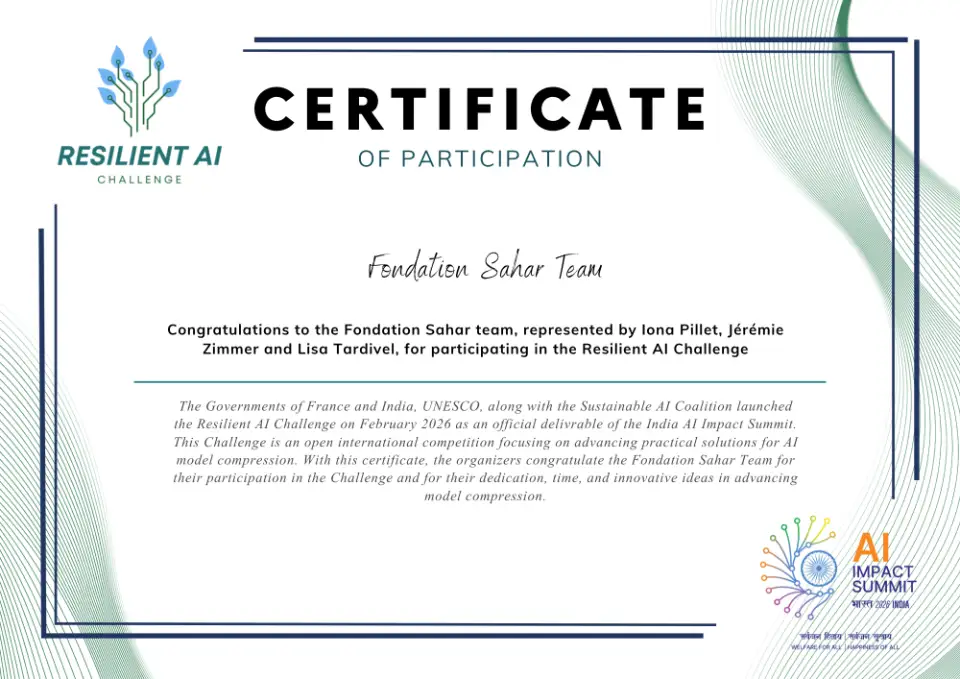
From February to July 2026, Fondation Sahar competed in the audio-to-text category of the Resilient AI Challenge, the first global competition focused on AI model compression. Our goal was to demonstrate that a speech transcription model can use less energy while maintaining strong performance.
The challenge was launched by UNESCO, France and India. It is organised in cooperation with the Coalition for Sustainable AI, of which we are a member, and with the support of the ITU. The principle is to take an open-source reference model and make it as energy-efficient as possible, while retaining at least 80% of its original quality.
Three categories were open, each paired with a base model provided by an industry player:
Audio-to-Text: Voxtral Realtime by Mistral AI (4.4 billion parameters, 13 languages)
Image-to-Text: Gemma 3n by Google
Text-to-Text: Sarvam-30b by Sarvam AI
The evaluation was based on absolute energy consumption, in kWh, measured across the full benchmark suite using CodeCarbon on NVIDIA L4 GPUs.
Our approach
We chose to work on Voxtral Realtime, an audio transcription model. Its architecture includes a causal audio encoder with 970 million parameters, an MLP adapter and a language decoder with 3.4 billion parameters. This multimodal model is designed for real-time use, so compressing it involves different constraints from those of a standard text model.
An AI model stores its knowledge as billions of parameters, which are numerical values. These values are usually encoded with high precision (32 or 16 bits). Quantisation means representing them with fewer bits (8 or even 4). The model then takes up less memory, runs faster and uses less energy.
After exploring several options, we chose dynamic FP8 quantisation through the vLLM inference engine. Weights are converted to 8 bits when the model is loaded, and activations are converted on the fly during inference. The weights stored on disk remain unchanged. The audio encoder and the adapter were deliberately excluded from quantisation to preserve transcription quality.
This choice was guided by the energy measurements we ran with CodeCarbon. They showed us that the most aggressive method is not necessarily the most efficient.
Our results
In Round 2, the final evaluation, our model met the quality threshold and significantly reduced its energy consumption.
MCTE (1st): 162.16 kWh, Recovery of 113.2%
Fondation Sahar: 216.70 kWh, Recovery of 100.8%
Base model: 307.67 kWh, Recovery of 100%
The compressed model we submitted uses 29.6% less energy than the base model. Its Recovery score reaches 100.8%, against a minimum threshold of 80%. This score compares transcription quality with that of the original model: above 100%, the compressed model outperforms the original on the benchmarks.
In other words, our model transcribes as well as the original while using nearly 30% less energy.
What we tested
Voxtral’s multimodal, streaming architecture ruled out several compression techniques. Here is what we explored and what we found.
What worked
Dynamic FP8 quantisation: when the model loads, the vLLM inference engine automatically converts the weights from 16 to 8 bits. The model files on disk are not modified. The energy gain is measurable and quality is preserved.
Quantising only the language decoder: the audio encoder, the part that “listens” to the sound, is highly sensitive to precision loss. By quantising only the decoder, the part that “writes” the text, we protect transcription quality.
Energy measurement: we built a robust measurement pipeline using the CodeCarbon tool.
What didn’t work
AWQ quantisation (a method that identifies the most important weights in order to preserve them): the model could not be loaded. The tool does not support the specific configuration of Voxtral’s audio encoder.
GPTQ quantisation of the whole model (a method that reduces weights to 4 bits while compensating for errors layer by layer): PyTorch’s analysis component fails on the causal audio encoder.
FP8 KV cache (storing the model’s intermediate results in 8 bits to save memory): this option requires the FlashInfer library, which is incompatible with Voxtral’s attention architecture on vLLM 0.17.1.
MXFP8 quantisation (a variant that groups weights into blocks before reducing them to 8 bits): it compresses more in theory. However, the tool that runs it, the Marlin kernel, proved slower in our tests and therefore more energy-hungry.
Reducing the context window (limiting how much audio the model keeps in memory at any given moment): no significant gain in either energy or quality.
Key takeaways
This challenge confirmed that model compression is not just about size. It is a concrete lever for AI that is more efficient, faster and more accessible. Our tests also showed that a more aggressive method is not necessarily a more efficient one: only real-world energy measurement can settle the question.
Cutting the energy consumption of an audio transcription model by 30% without degrading its quality is possible today with open-source tools. Fondation Sahar will continue to explore these methods and document them for the community.
We would like to thank the organisers, as well as Mistral AI for making the Voxtral Realtime model available. Our thanks also go to Hugging Face, AIKosh, Capgemini Invent, Pruna AI and all the challenge partners.
Our team remains available to discuss this topic.
Further reading: the resources that helped us
MIT HAN Lab / Pruna AI course, How to Prune / Quantize / Distill Deep Learning Models: the ideal starting point to understand the three main families of compression (pruning, quantisation, distillation), with concrete and visual examples.
Pruna AI (pruna.ai): practical tools and documentation on model optimisation, with energy efficiency benchmarks.
Awesome AI Efficiency (github.com/PrunaAI/awesome-ai-efficiency): a GitHub repository gathering the key papers, tools and frameworks on AI model efficiency.
EcoLogits Calculator (huggingface.co/spaces/genai-impact): to estimate the environmental footprint of a request to an AI model.
LLM-Perf Leaderboard (huggingface.co/spaces/optimum): Hugging Face’s ranking of models by performance/efficiency ratio, useful for comparing quantisation formats.
AI Energy Score Leaderboard (huggingface.co/spaces/AIEnergyScore): a ranking of models by their actual energy consumption.
Voxtral Realtime paper (arXiv:2602.11298): the technical paper on the model we compressed, essential for understanding its architecture and constraints.
Energy & AI Observatory (International Energy Agency, 2025) and The 2025 AI Index Report (Stanford HAI): for the global context on AI’s energy impact.